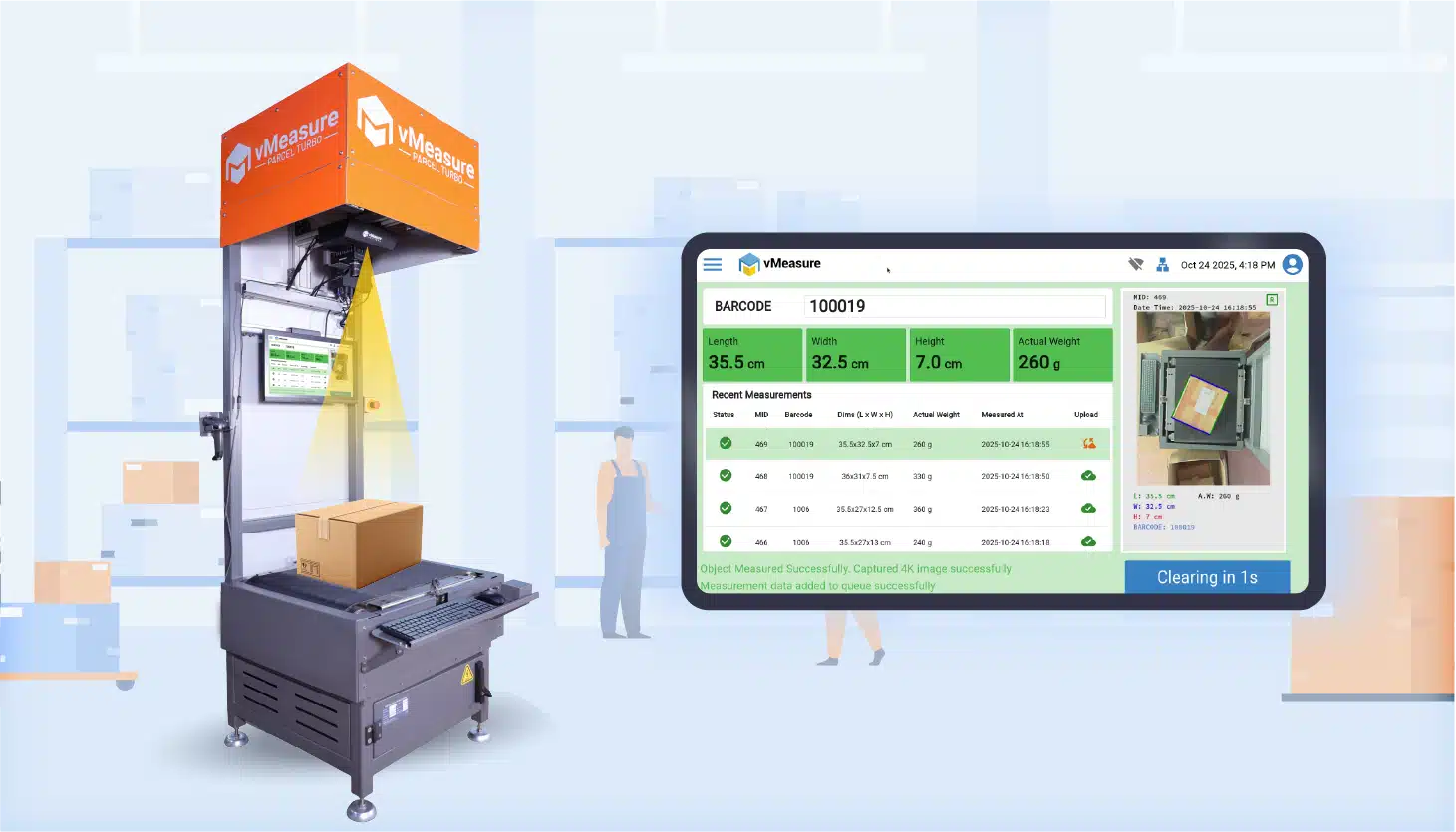
Most parcels leave the pack station without accurate dimensions recorded. A shipping label gets printed, the box is sealed, and the shipment goes out. The real dimensions often come into play only when the carrier scans the parcel, and that is when surprises happen.
If your numbers do not match the carrier’s, the difference shows up as a chargeback or a billing dispute. It can also cause delays when shipments are flagged for recheck. Dimensional measuring systems help warehouses, 3PLs, retailers, and freight teams capture the right parcel or pallet size before it leaves the facility.
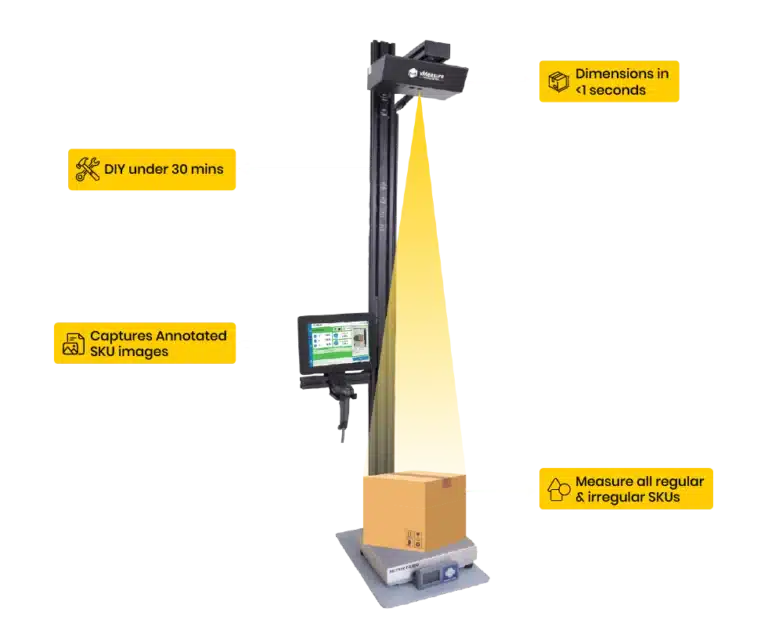
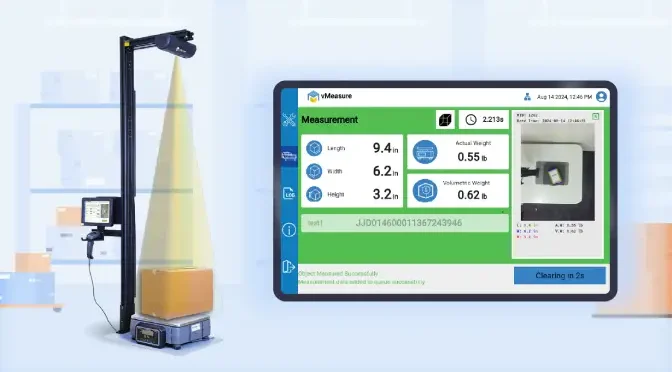
Instead of using tape measures or entering numbers manually, the system captures dimensions, weight, barcode data, and shipment images in one workflow. So the team gets a cleaner shipping record and fewer surprises after dispatch.
What is a dimensional measuring system?
A dimensional measuring system is an automated tool that uses sensors or computer vision technology to capture the length, width, and height of parcels, SKUs, cartons, and palletized freight. Depending on the system, it also records weight, barcode data, images, and timestamps.
The captured measurement data can be sent directly to your WMS, TMS, ERP, or shipping software for inventory records, packaging, billing, and shipment verification.
For parcel shippers, accurate dimensions are especially important for DIM weight calculations, where even a small difference in package size can change the final billable weight.
How can inaccurate parcel measurements affect DIM weight billing?
It can have a bigger impact when a lower divisor applies, as seen with the USPS DIM divisor change from 166 to 139, because the same package volume results in a higher DIM weight. That is when the penalties start to show up.
- Recorded: 18 × 18 × 18 in
Volume: 5,832 in³. With a DIM divisor of 139, the DIM weight is 41.96 lb. Most carriers round up, so you pay for 42 lb.
- Actual: 19 × 18 × 18 in
Volume: 6,156 in³. DIM weight is 44.30 lb. Rounded, you pay for 45 lb.
That single inch adds 3 lb of billed weight. If the zone rate steps up from $1.20 to $1.80 per pound at that bracket, you are paying several dollars more per parcel. That might not feel big on one label, but across 1,000 labels a week, it quietly adds up to five figures a quarter.
The hidden costs you feel later
- Lower trailer utilization, which means paying for more trucks than you need
- Slower claim resolution when your records do not match the carrier’s
- Extra labor spent on re-measuring, repacking, and explaining disputes
The damage is not obvious on the first day. It builds over time. That is why many teams move from manual tools to dimensional measuring systems. The purpose is not to buy fancy equipment. The purpose is to stop paying for the inch that slips past unnoticed.
Why are dimensional measuring systems important in shipping and fulfillment?
If a parcel or pallet is measured incorrectly before shipping, the wrong dimensions can affect DIM weight, shipping charges, and the data sent to carriers. When this happens across hundreds or thousands of shipments, small measurement errors can lead to carrier adjustments, billing disputes, and repeated rechecks.
Dimensional measuring systems capture accurate shipment dimensions automatically before the freight leaves your facility. This gives you reliable data for shipping cost calculations, label generation, freight billing, and shipment verification.
The captured data can also be sent directly to your WMS, TMS, ERP, or shipping software, reducing manual data entry and keeping measurement data consistent throughout the shipping workflow.
How do dimensional measuring systems work?
The process looks simple on the surface but powered by precise technology.
A warehouse employee places the parcel on the automated dimensional measuring systems’ platform or on the conveyor.
3D Sensors or computer vision-based cameras capture the parcel’s length, width, and height in seconds.
Many systems have an integrated weight scale. As the box is measured, weight is recorded at the same time. This eliminates the need for a second step on a separate weighing station.
The dimensional measuring system instantly transfers the measurements to your existing WMS, OMS, TMS or shipping software via no-code API and webhooks. No typing, no rechecking.
vMeasure dimensional measurement systems also capture a timestamped image of the parcel. This record can be used later to resolve disputes with carriers or customers.
In practice, this workflow means a worker can measure and process a parcel in under two seconds instead of half a minute. Multiply that across hundreds of parcels and the savings in both labor and cost are clear.
The technology does not just speed up work. It builds consistency. Every parcel is measured the same way, every time, regardless of who is working at the station. That consistency is what keeps correction fees and disputes from piling up.
What types of dimensional measuring systems are available in the market?
Parcel shippers and freight handlers do not all need the same setup. Some process a few boxes an hour. Others move thousands a day. Dimensional measuring systems come in several forms to match these very different needs like:
1. Static Parcel Dimensioning Systems
Static dimensional measuring systems are compact setups used at packing stations. A worker places a parcel under parcel dimensioning system, and the system records length, width, height, and often weight. These are well-suited for e-commerce shippers and 3PLs handling medium order volumes.
They offer a balance of cost and control. One operator can process orders without guesswork, and every parcel is measured consistently before it leaves the floor.
2. Pallet Dimensioning Systems
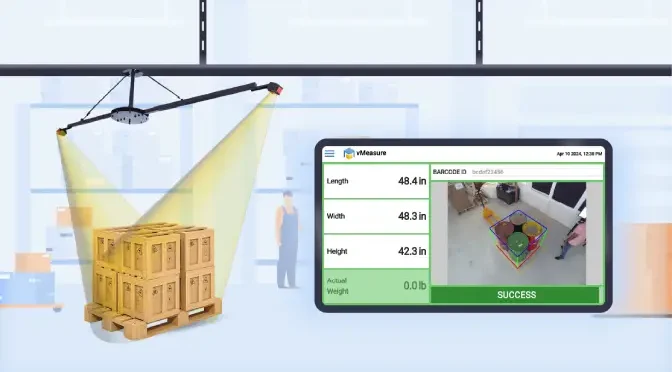
Pallet systems measure freight and overhangs. Instead of scanning individual parcels, they capture the dimensions of a fully palletized shipment. These systems are common in LTL shipping, distribution centers, and cross-dock facilities where pallets move directly onto trailers
They help carriers and shippers calculate density, confirm NMFC classifications, and reduce the risk of reclass disputes. Many 3PLs and warehouses that manage both parcels and freight use pallet dimensioners alongside parcel systems to cover all shipment types.
3. Conveyor-Based Parcel Dimensioning Systems
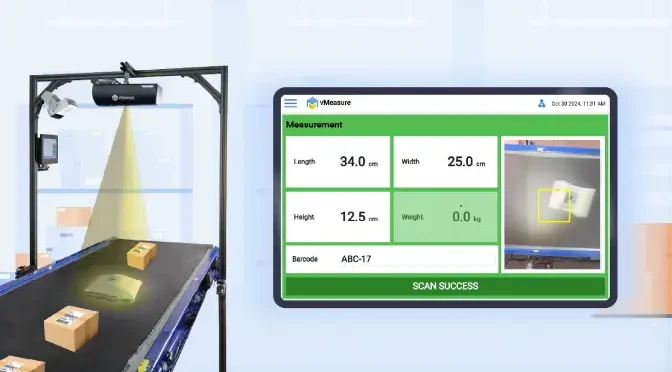
Conveyor systems are built for speed. Parcels move down a conveyor belt, and the system measures them automatically as they pass. Dimensions, weight, barcodes and even images are captured in motion.
These conveyor-based dimensional measuring systems fit high-volume operations like fulfillment centers or carrier terminals where throughput is critical. They often tie into sortation lines, letting warehouses measure, weigh, and route parcels in one continuous flow.
4. Mobile or Handheld Dimensioning Tools
Mobile systems,
such as iOS applications, turn an iPhone into a handheld scanner. Carriers and couriers often use these dimensional measuring apps in field operations like pickup and delivery to ensure instant parcel verification.
How accurate are dimensional measurement systems?
The required accuracy also depends on the measurement range, mounting position, and the size and shape of the shipment.
Irregular packages, overhangs, protrusions, and uneven pallet loads require systems designed to capture their outer dimensions correctly.
Can dimensional measurement systems measure irregular or non-box items?
Yes. Computer vision-based dimensional measuring systems measure irregular parcels, polybags, soft packs, non-cuboid items, and palletized freight with overhangs or protrusions.
The system captures the outermost points of the shipment to determine its dimensions instead of assuming a standard box shape.
What are the benefits of using dimensional measurement systems?
Dimensional measuring systems do more than speed up a process. They solve problems that directly affect cost, compliance, and customer experience. Here are the main benefits.
Accurate billing: Carriers charge by dimensional weight, not just actual weight. These systems ensure your records match theirs. That means fewer chargebacks, fewer disputes, and cleaner invoices.
Faster processing: Manual measuring takes half a minute per parcel. This system does it in seconds. In high-volume shipping, the time saved per box adds up to hours saved each day.
Consistent results: Measurements are the same regardless of who is working at the station. This builds carriers trust and gives teams reliable data to work with.
Lower labor costs: Automated dimension capture reduces the need for workers to spend time measuring, rechecking, and typing numbers into a system. Staff can focus on packing, loading, and other tasks that move shipments forward.
Software integration: Measurements flow directly into your existing WMS, TMS, or carrier software. That removes manual entry errors and creates a real-time view of shipping costs and trends.
Customer confidence: Images and accurate dimensions give a record that can be shared if a customer disputes a shipment. Having proof on file reduces back-and-forth and shows professionalism.
Which industries use dimensional measuring systems?
Industries that rely on accurate parcel, product, or freight dimensions use dimensional measuring systems to improve workflow efficiency.
Warehouses and fulfillment centers: Capture SKU and package dimensions to support inventory management, packaging, and outbound processing.
Manufacturers and OEMs: Use dimensional records to support SKU verification, packaging optimization, inventory management, and quality audits across production and dispatch workflows.
3PLs and freight forwarders: Capture parcel and pallet data for customer billing, freight verification, consolidation, and carrier rate calculations.
Carriers and parcel operators: Verify shipper-declared parcel or freight dimensions to support accurate rating and billing.
Retail and e-commerce shippers: Capture package dimensions for accurate shipping labels, DIM-weight calculations, and carrier rate selection.
Where are dimensional measuring systems used?
Dimensional measuring systems are used at different points in the shipping workflow, depending on what needs to be measured and how freight moves through the operation.
Common locations include:
- Receiving areas: Capture parcel or pallet dimensions as goods enter the facility.
- Packing stations: Measure parcels before rate calculation and label generation.
- Conveyor lines: Capture dimensions automatically as parcels move through high-volume shipping operations.
- Outbound shipping areas: Verify shipment dimensions before carrier handoff.
- Pallet measurement zones: Measure palletized freight before staging, billing, or dispatch.
How do you choose the right dimensional measuring system for shipping?
To choose the right dimensional measuring system, consider what you ship, your shipment volume, and where dimension capture fits into your shipping workflow.
- Shipment volume: Match the system throughput to the number of parcels or pallets you process each day.
- Shipment type and size: Choose a measurement range that fits the parcels, polybags, irregular packages, or palletized freight you regularly ship.
- Available workspace: Select a mounting or installation option that fits your packing station, shipping area, conveyor, or pallet measurement zone.
- Software integration: Make sure the system sends measurement data directly to your WMS, TMS, ERP, or shipping software for rate calculation, label generation, and shipment records.
- Measurement accuracy: Choose the level of dimensional accuracy required for your shipping, billing, and carrier workflows.
- Budget and ROI: Compare the system cost with the time spent on manual measurement, billing corrections, carrier adjustments, and other shipping costs caused by inaccurate dimensions.
The best fit is the system that matches your shipment profile, required throughput, available space, and existing shipping workflow.