Every supply chain industry, from e-commerce fulfillment centers to 3PL warehouses, knows this truth: how big a package is can matter more than how heavy it is.
If you’re still relying on traditional tape measures and manual methods, you’re not just behind the trend. You’re silently draining profits through wasted space, billing errors, and slow operations.
For a 3PL handling thousands of parcels a day, an eCommerce brand managing razor-thin margins, or a carrier safeguarding revenue, the way dimensions are captured influences more than shipping bills. Accurate measurements are fundamental to efficient shipping, inventory management, and warehouse optimization.
Dimensioning technology has moved far beyond tape measures and basic laser tools. Most modern dimensioners capture these measurements in seconds, providing precise data that helps make smarter decisions. As technology advances, dimensioning tools have evolved from manual tape measures and laser scanners to intelligent camera-based vision systems.
Learn why the shift from traditional sensors to computer vision systems is gaining momentum.
What is dimensioning technology?
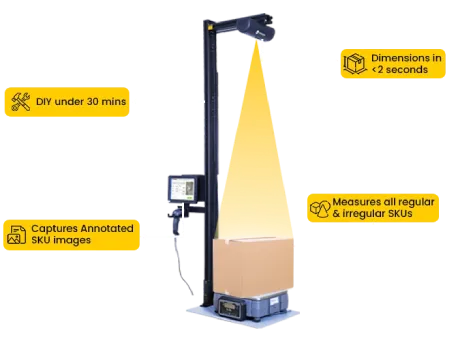
Dimensioning technology is an automated system that uses various technologies such as 3D, laser-based, and computer vision to capture the size of an object. These systems measure length, width, height, and often weight, recording the data in <2 seconds and storing it in a usable format.
The push for automation isn’t theoretical. Carriers bill parcels by dimensional weight, which means that the space a parcel takes up can cost more than the parcel’s actual weight. On top of that, freight forwarders and LTL carriers handling palletized freight are shifting toward density-based classification in line with the latest NMFC changes. Globally, shipment throughput demands are climbing, and slow or inaccurate measuring directly cuts into profit.
Dimensioning falls into two main spheres:
- In logistics, it refers to the systems that measure parcels, pallets, or irregular freight for shipping, billing, and storage.
- In manufacturing and metrology, the same concept applies to precision measurement of components, often down to microscopic tolerances.
But for 3PLs, shippers, eCommerce retailers, and carriers, logistics-focused dimensioning is where operational gains or financial losses are felt most immediately.
What are the types of dimensioning technologies and how do they work?
Dimensioning technology includes a range of approaches. Some legacy systems still hold value in certain warehouse operations, while newer solutions rely on advanced optics and AI.
Here are the major types of dimensioning technologies in the market:
Laser-based Systems
In order to determine an object’s size, lasers project a line across it and use the reflection. They function well in static situations and are quick and extremely accurate on spotless surfaces. The downside? Reflective packaging, glossy tape, or jet-black surfaces can throw the readings off. In a warehouse that deals with mixed freight, this becomes a recurring headache.
3D Structured Light and LiDAR
These devices create intricate 3D maps of objects by projecting a pattern of light or by delivering laser pulses. They’re excellent for handling irregular shapes and deliver strong accuracy. 3D dimensioning technologies are more expensive, though, and are sensitive to environmental conditions like dust or lighting. For operations that can justify the price, the payoff is solid.
Ultrasonic and Sensor-based Systems
Think of these as the entry-level option. They rely on simple sensors to estimate object size. Affordable and straightforward to install, they still serve small operations well. The trade-off is precision. Sensor based dimensioning technology struggles with complex or irregular freight and often miss the level of detail needed for strict carrier compliance.
Computer Vision Systems
Cameras combined with AI algorithms capture dimensions, shapes, and even surface details in real time. They handle reflective tape and curved packaging better than lasers. They scale from small parcel stations to pallet scanning, and they can evolve over time through software updates.
Why is computer vision taking the lead in dimensioning technology?
Traditional systems solved part of the problem. Lasers gave speed, sensors gave affordability, and LiDAR handled odd shapes when budgets allowed. But freight environments are messy, and these approaches often hit limits in real operations. That is where computer vision–based dimensioning technology has been gaining traction.
Accuracy that adapts
Instead of being locked into a fixed calibration, camera-based systems learn from the freight they see. A warehouse scanning hundreds of irregular boxes one week and more uniform cartons the next doesn’t need a new setup. The software adjusts, and accuracy stays consistent.
Captures beyond dimensions
Computer vision goes beyond length, width, and height. Alongside dimensions, these systems capture images, barcodes, and even item condition. That extra layer is valuable during audits and claims, when proof matters more than assumptions.
Flexible across freight types
One of the biggest advantages is coverage. The same vision system can capture a polybag, a standard parcel, cubes, old-shaped irregulars or an overhang pallet. That range means fewer hardware silos and fewer compromises when order profiles change.
Different ways to deploy
Some teams mount cameras at static stations, others place them on mobile carts, and larger facilities run them on conveyors. This dimensioning technology doesn’t lock you into one model, which makes scaling less painful.
Lower total cost over time
Because it uses commodity cameras paired with software, the upfront spend is often lower than laser systems. More importantly, improvements usually come through updates rather than new hardware. That keeps the total cost of ownership manageable.
Integration that fits existing systems
With no-code APIs or webhooks, these systems integrate directly with your existing WMS, OMS, or TMS, ERPs, etc, transferring dimensions instantly. No manual entry, no separate spreadsheets, just clean data feeding into the systems teams already rely on.
What are the limitations of using computer vision for dimensioning?
Every dimensioning technology brings strengths and its own drawbacks. Computer vision isn’t an exception. Here’s a closer look at its limitations.
The limitations to keep in mind
- Lighting sensitivity. Poor or inconsistent lighting can affect image capture unless correction algorithms are applied.
- Calibration needs. To keep its performance tight, regular calibration is required. Skipping it can erode accuracy.
Computer vision solves many long-standing gaps, but acknowledging the limits is what makes adoption realistic. Teams that prepare for calibration routines and hardware needs are usually the ones that see the strongest results.
Where do computer vision dimensioners add the most value?
Different industries face different measurement pressures and operating constraints, which is why dimensioning technology has to be flexible. Computer vision stands out because it adapts across workflows, item types, and environments.
3PLs and eCommerce Fulfillment
At
3PL pack stations, speed is everything. Workers can’t afford to measure boxes by hand when thousands of orders are queued. Dimensioners that use computer vision technology shorten the process by scanning and recording dimensions in <2 seconds with an accuracy up to 0.2 inches. The added accuracy reduces billing disputes with carriers, cutting back on costly adjustments that usually hit after the fact.
LTL Carriers & Freight Forwarders
For LTL carriers and freight forwarders, protecting ROI translates to billing every shipment accurately. Vision-based systems give them the confidence that dimensional weight calculations are right. As NMFC density rules tighten, the ability to prove exact measurements on pallets isn’t just convenient, it’s compliance-critical.
Returns Management
Returns bring a different challenge: proof. Retailers and 3PLs need more than numbers. They need to document condition. Computer vision-tech dimensioners capture both dimensions and annotated photos of parcels and SKUs, creating a reliable record of what was received. That log becomes essential when handling disputes over damage or fraud.
How does choosing the right dimensioning technology support compliance and audit readiness?
Choosing the right dimensioning technology makes compliance and audits far easier. When a shipment is reviewed, estimates are not enough. You need measurements that carriers recognize and records that stand up to scrutiny.
Carriers do not rely on explanations or manual notes. They rely on data they can check. If your measurements cannot be validated, the charge gets adjusted and the conversation usually ends there.
This matters even more with density-based pricing. As freight is increasingly billed by the space it takes up, small measurement errors add up fast. A half-inch mistake may seem minor, but across thousands of pallets, it turns into real cost exposure for shippers and 3PLs.
Computer vision-based dimensioning technology adds another layer of protection by keeping visual proof tied to every scan. Each record includes images, calibration logs, and measurement data. When a carrier questions a shipment, teams can pull the scan and show exactly what was measured. In most cases, that ends the debate.
That is why NTEP-certified dimensioning systems like vMeasure matter. They generate measurements that are recognized in billing disputes and carrier audits. Without certified data, you are effectively comparing a tape measure to a carrier scan, and the carrier scan wins.
What does the future of dimensioning technology look like?
The dimensioning technology and those tools are shifting fast. A few years ago, only big carriers or high-volume DCs could justify advanced scanners. Now smaller operators are picking up mobile apps or handheld vision tools that do a decent job without a massive install. It lowers the barrier and puts automated measuring in more hands.
AI is another layer. Vision systems are already good, but they’re getting better at spotting irregular shapes on their own. Instead of a worker flagging a carton as “odd,” the software can adjust on the fly. The more data it sees, the smarter it gets.
Cloud platforms are quietly changing the pace too. Once dimension data lives online, it’s not just a shipping detail. It becomes business intelligence. Managers can see which SKUs eat up space, which zones move slower, and where cube utilization slips. That kind of insight was rare before.
And then there’s consolidation. Most warehouses don’t want five separate devices. The push is toward multi-modal systems that capture weight, dimensions, photos, and barcodes in a single step. Less clutter, cleaner data, fewer chances for error.
If the last decade was about replacing tape measures, the next one will be about turning dimension data into strategy.
The shift is already happening. Warehouses that once leaned on tape measures or fixed laser rigs are moving toward vision-based setups. Not because it’s trendy, but because it clears bottlenecks and protects margins.
For teams handling fast-moving freight, computer vision dimensioning technology is becoming the practical choice for staying accurate, compliant, and ready for what comes next.
Frequently asked questions