
What is an automated freight dimensioning system?
A single warehouse can survive with manual pallet measurements for some time.
The problem starts when volume increases, more sites are added, and every location starts measuring pallets in its own way. One team measure at receiving. Another measures at dispatch. One site stores photos. Another only enters dimensions in a spreadsheet. Some records are tied to shipment IDs. Some are not.
At that point, the issue is no longer only pallet measurement. The real issue is consistency across the warehouse network.
Quick Answer: What is a scalable pallet dimensioner system?
A scalable pallet dimensioner system captures pallet length, width, and height automatically, then sends the data to the cloud and can be easily integrated with your existing WMS, TMS and ERP solution. It is designed for operations that expect higher pallet volume, multiple sites, or future expansion. The best system supports repeatable measurement, API integration, centralized access, and a clear support model.

Why pallet measurement becomes harder as warehouse networks grow
When the operation is small and the pallet volume is low, you can use a tape measure, enter values manually, and fix errors when they appear.
But as the business grows, the process becomes harder to control.
| Growth stage | What usually happens | Why it becomes a problem |
|---|---|---|
|
One site, low volume |
Manual measurement is manageable |
Errors are easier to catch |
|
One site, higher volume |
Operators measure more pallets each day |
Manual work slows receiving, staging, or dispatch |
|
Multiple shifts |
Different operators measure differently |
Records become inconsistent |
|
Multiple sites |
Each site creates its own process |
Leadership loses standard visibility |
|
Enterprise network |
Pallet data needs to feed WMS, TMS, ERP, or freight systems |
Standalone records create reporting and audit gaps |
How do you choose a scalable pallet dimensioning system?
What you should look for in a scalable pallet dimensioning system when there are multi-sites in your operations?
1. A standard measurement process
- Pallet reaches the scan point.
- Operator scans or enters the shipment ID, pallet ID, BOL, LPN, PO, or order reference.
- System captures length, width, and height.
- Image proof is saved where required.
- Weight is captured if the workflow uses a compatible and validated scale.
- Scan record is stored.
- Data moves to the next system through export or integration.
- Pallet moves to staging, storage, dispatch, or carrier handoff.
2. Centralized records and searchability
- Shipment ID
- Pallet ID
- Order number
- BOL
- Customer
- Site
- Scan date
- Operator or station
- Dimension range
- Exception or audit need
A cloud connected dimensioning solution can help operations, freight, finance, or support teams access measurement records without asking each site to send screenshots or spreadsheets.
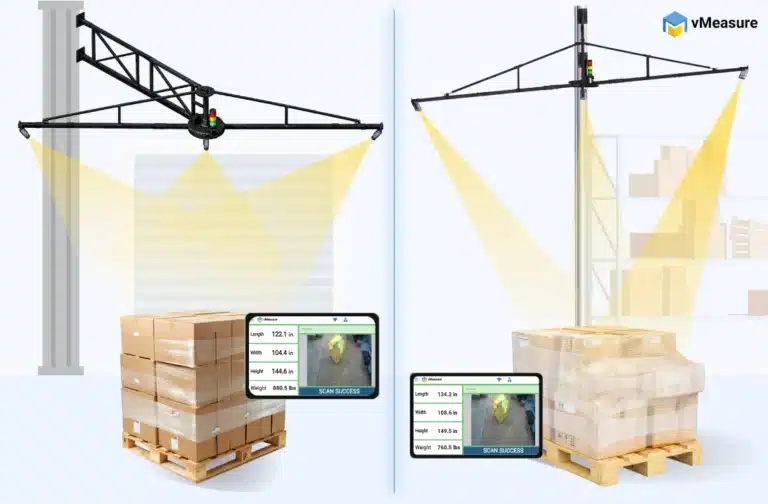
Static, automated, or enterprise pallet dimensioning: which system scales better?
| System type | Best fit | Scaling consideration |
|---|---|---|
|
Manual measurement |
Low-volume or occasional pallet measurement |
Hard to standardize across shifts and sites |
|
Mobile measurement |
Flexible areas where pallets do not follow a fixed route |
Useful for flexibility, but process control can vary by user and environment |
|
Static pallet dimensioning |
Warehouses where pallets already stop at defined checkpoints |
Scales well when each site has a repeatable scan point |
|
Automated pallet dimensioning |
Higher-throughput workflows where stopping pallets creates delay |
Needs stronger layout control and deployment planning |
|
Enterprise pallet dimensioning solution |
Multi-site teams that need records, integrations, reporting, and governance |
Best when the business wants standard process and centralized visibility |
Enterprise governance: why it matters for pallet dimensioning
| Governance area | Decision to define |
|---|---|
|
Process owner |
Who owns the pallet measurement process? |
|
Data owner |
Who defines required fields and record quality? |
|
Site owner |
Who manages local usage and training? |
|
Integration owner |
Who manages WMS, TMS, ERP, or freight system handoff? |
|
Reporting owner |
Who reviews scan history and site-level performance? |
|
Exception owner |
Who handles missing IDs, failed scans, or data mismatches? |
|
Change control |
How are new sites, workflows, or fields added? |
Cost factors for a scalable pallet dimensioner system
Hardware setup
- Cameras, sensors, structure, scan zone, and station design vary by workflow
- Higher automation may require more setup and site control
- Cloud records, search, reporting, and user access may affect cost
- WMS, TMS, ERP, and freight software connections add implementation work
- Weight capture may require validation of scale model, indicator, output mode, cable, and data format
- Floor space, clearance, traffic, power, network, and lighting affect deployment
- Training, post-go-live assistance, and service coverage matter for uptime
Where vMeasure pallet dimensioning system fits
- Capture pallet-level length, width, and height
- Link scan records to barcode, shipment ID, or other business references
- Save image proof where required
- Store scan records in vMeasure Forge
- Support review, export, and integration workflows
- Use approved integration paths such as REST API, webhooks, CSV or JSON export, SFTP or flat file, browser extension, vMeasure Desk, RPA-style bot, or serial-style transfer
- Place a fixed scan station where pallets already stop
- Support receiving, pallet audit, dispatch verification, staging, dock, scale, wrapper, or carrier handoff workflows
Talk to the dimensioning experts
What do our customers say?

Bargain Book Stores

Holisol

Pidge