
For many warehouses, pallet scanning has always been a practical challenge.
To capture pallet information, warehouses generally use handheld barcode scanners, fixed readers, camera stations, or manual checks. These tools can help identify a pallet, read a label, capture a shipment ID, or store an image. But in many cases, they still do not capture the one thing needed for freight and warehouse records: the actual pallet dimensions
Here we need to look at the difference between a pallet scanner and a pallet dimensioner.
What Is a Pallet Scanner?
A pallet scanner is a general term for a system that captures pallet-related information, such as barcode, ID, image, or visual data.
In daily warehouse language, “pallet scanner” often describes the first step in identifying a pallet. An operator scans a barcode, pallet ID, SSCC label, LPN, shipment ID, BOL, PO, or other reference. That scan tells the system which pallet is being
Some pallet scanning systems only capture identification data. Some capture images. Some check labels.
A pallet dimension scanner goes further by measuring the physical size of the palletized load.
What Is a Pallet Dimensioner?
A pallet dimensioner goes further by measuring the physical size of the palletized load.
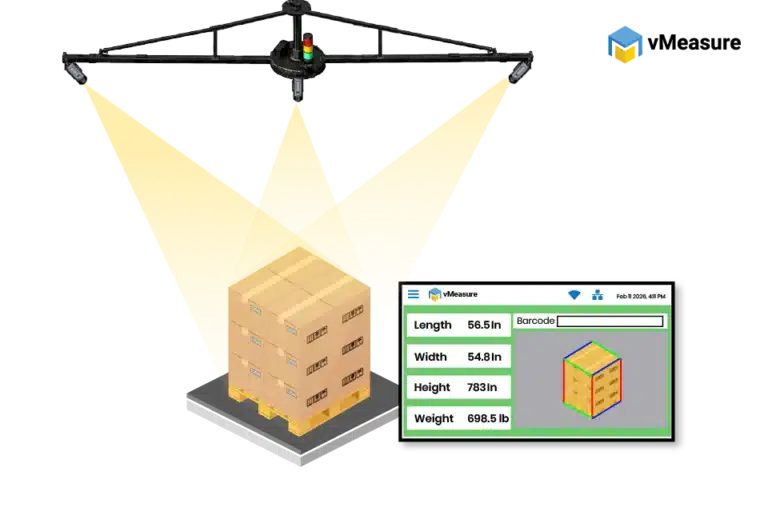
It captures the pallet’s length, width, and height and creates dimension data that can be used for shipping, billing, warehouse records, load planning, and audit trails.
Along with the dimensions of the pallet it also captures
- Cubic volume
- Pallet image
- Shipment ID
- Weight, when integrated with a scale
- Exportable records for WMS, TMS, ERP, or reporting tools
vMeasure pallet dimensioner accurately captures the pallet dimensions of large, wrapped, irregular, or multi-SKU pallets in under 2 seconds.
See how vMeasure fits your pallet measurement process.
Pallet Scanner vs Pallet Dimensioner
A pallet scanner may only scan a label or capture an image. A pallet dimensioner captures actual size data such as length, width, and height. Some advanced systems may combine both functions, which is why buyers often see terms like pallet dimension scanner or warehouse dimension scanner system.
The easiest way to separate them is this:
| Differentiator | Pallet Scanner | Pallet Dimensioner |
|---|---|---|
|
Does it scan a barcode or label? |
Yes |
Sometimes |
|
Does it capture a pallet image? |
Sometimes |
Often |
|
Does it measure length, width, and height? |
Not always |
Yes |
|
Does it create dimension records? |
Not always |
Yes |
|
Can it support freight billing data? |
Limited |
Yes, when configured for that workflow |
|
Can it help with overhanging or wrapped pallet records? |
Only as image proof |
Yes, if the dimensioning method supports the load type |
|
Can it connect to WMS, TMS, or ERP? |
Sometimes |
Often, depending on system design |
Why Pallet Dimensions Matter in Freight Workflows?
In pallet and LTL freight, dimensions matter because they affect cube, density, freight class, trailer space, load planning, and reclassification risk.
A pallet that is entered as 48 x 40 x 48 inches but measures 48 x 44 x 60 inches can change the space it occupies and the freight record attached to it.
A pallet dimensioner captures those measurements and connects them to the shipment record. That becomes useful when you need to check declared vs actual dimensions and helps you avoid freight audit penalties under NMFC
Buyer Checklist: How to Choose Between a Pallet Scanner and Pallet Dimensioner
Before choosing a system, ask these questions:
| Buyer Question | Why It Matters |
|---|---|
|
Do we only need barcode or label scanning? |
A basic scanner may be enough |
|
Do we need length, width, and height? |
You need a pallet dimensioner |
|
Do we handle wrapped pallets? |
Check system capability for wrapped loads |
|
Do we handle overhanging loads? |
Check how the system detects outer dimensions |
|
Do we need image proof? |
Look for pallet image capture |
|
Do we need weight data? |
Check floor scale or forklift scale integratio |
|
Do we need WMS, TMS, or ERP integration? |
Check API, webhook, or CSV options |
|
Do we use the data for billing? |
Check certification and audit needs |
|
Do we need reports? |
Look for cloud records and dashboard options |
The wrong purchase usually happens when the buyer asks for a “scanner” but the business problem is measurement.
How vMeasure Fits
vMeasure pallet dimensioner fits when your warehouse needs to capture pallet dimensions, pallet images, and shipment-linked records in a structured workflow.
For a buyer comparing a pallet scanner with a pallet dimensioner, the main value is clarity. If your team only needs barcode scanning, a simple scanner may solve the problem. But if your team needs length, width, height, visual proof, and dimension data capture, a pallet dimensioning system is the better fit.
vMeasure pallet dimensioning solutions are designed for operations where pallet size affects freight billing, warehouse records, dispatch, audit, or customer communication. The fit is strongest when your team handles wrapped pallets, overhanging loads, palletized freight, or manual measurement delays.
The goal is to create a reliable pallet measurement record.
Talk to the dimensioning experts
Still unsure about procuring our dimensioning system for your operations to capture the accurate dimensions, weight, and volume of your SKUs or parcels?
What do our customers say?
"…They are now indispensable components in our shipping process and have allowed us to predict shipping costs accurately…"

Bargain Book Stores
"...vMeasure provided excellent support throughout the product integration process, with readily available and effective after-sales assistance…"

Holisol
"...With vMeasure, we were able to take the cloud-based solution literally under a day and under a far more achievable budget..."

Pidge