
Dimensioners that measure anything from parcels to pallets
vMeasure Dimensioner

Pallet Freight Measurement System: Capturing Dimensions, Weight, and Proof Together

When a pallet arrives at the dock, measuring it is rarely one clean step. It may go to one station for dimensions, another for weight, while shipment information is entered somewhere else. What should be one freight event turns into several disconnected entries, adding handling time and increasing the chance of mismatched data.
A pallet freight measurement system brings those steps into one station. The pallet moves through a single capture point, where a complete freight measurement record is created as part of the same workflow.

What is a pallet freight measurement system?

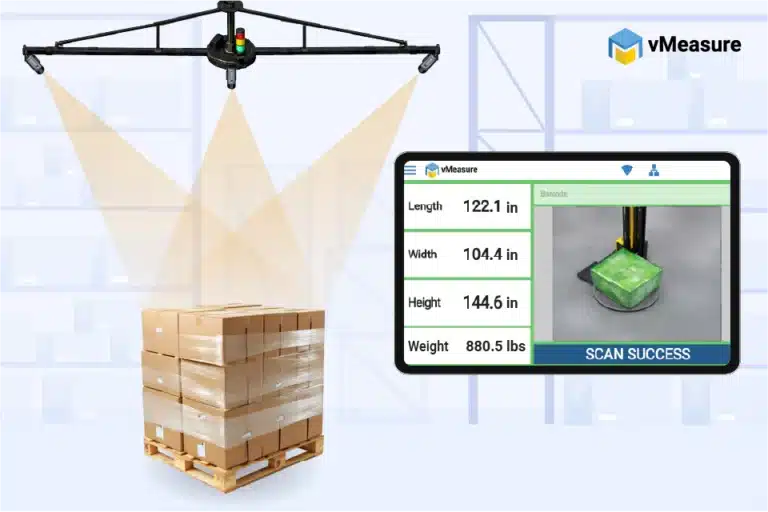
vMeasure Pallet Three camera setup

A pallet freight measurement system is a dimensioning setup that combines freight measurement hardware, compatible weighing equipment, and software to capture the physical data of palletized freight.

Based on the technology, the system uses sensors, lasers, or computer vision cameras to measure the full outside profile of a loaded pallet. This includes stretch wrap, overhanging cartons, uneven stacking, corner protection, and any protruding parts that add to the space the freight occupies.

To take a measurement, the pallet is moved into the system’s capture area. The freight dimensioning and weighing system detect the outer edges, measure the length, width, and height, and records the actual weight from a connected scale. The software then processes and stores the data for use in freight and warehouse operations.

Why should pallet dimensions and actual weight be captured together?

Pallet dimensions and actual weight should be captured together because both are needed to describe the same load. Dimensions show how much space the pallet occupies, while actual weight shows how heavy it is.

Together, these values give a complete physical profile of the freight. Two pallets may both weigh 500 pounds, but one might be compact while the other is tall, overhanging, or loosely packed. The scale shows the same number, even though the pallets take up very different amounts of space.

The measurements also need to come from the same version of the pallet. If the load is measured before wrapping but weighed after more cartons are added, the dimensions and weight no longer describe the same pallet. Capturing both at the same stage keeps the physical measurements consistent.
static pallet dimensioning at shipping dock

How does a pallet freight measurement system create a complete freight measurement record in one workflow?

A pallet freight measurement system creates a complete freight measurement record by capturing the barcode, dimensions, actual weight, when connected with a compatible floor scale, and timestamped images during the same workflow. The software links all of this information to the correct pallet or shipment ID.

This keeps the measurements, identification, and visual proof together rather than storing them in separate systems.
The record may also include:
  • Measurement date and time
  • Device or station reference
  • Operator reference
  • Original scan and rescan history
  • Export status or data transfer details
Warehouse operators can search for the record using the pallet or shipment reference. If the pallet is measured again, the software adds the new scan to the same history while keeping the earlier measurement available.
Capture a complete freight record in a single workflow.

How are pallet dimensions used in dimensional weight calculations?

Pallet dimensions are used in dimensional weight calculations to calculate how much space the freight takes up. The measured length, width, and height are multiplied to find the cubic volume of the loaded pallet. These measurements should cover the pallet’s full outer profile, not just the base.

Dimensional weight = Length × Width × Height ÷ dimensional factor

For example, a pallet measuring 48 inches long, 40 inches wide, and 48 inches high would be calculated as follows using a dimensional factor of 139:

48 × 40 × 48 ÷ 139 = 663 pounds

The dimensional factor varies by carrier, service, transportation mode, trade lane, or customer agreement.

How is billable weight decided from actual and dimensional weight?

Billable weight is decided based on either the pallet’s actual weight or its dimensional weight. Actual weight is the physical weight recorded by the floor scale. Dimensional weight turns the space occupied by the pallet into a weight value.
In many freight workflows, the two figures are compared, and the higher one is used for billing. The exact rule depends on the carrier, service, transport mode, tariff, or customer agreement.
A pallet may have an actual weight of 700 pounds and a dimensional weight of 550 pounds. Under a higher-of-the-two rule, the billable weight would be 700 pounds. The reverse applies when the dimensional weight is higher. If the dimensional weight is 900 pounds, the shipment would be billed at 900 pounds instead.
The pallet freight measurement system records the pallet dimensions and actual weight. The connected freight or rating system then applies the relevant rule and determines the billable weight.
Generate accurate freight bills using actual and dimensional weight.

How does a pallet freight measurement system improve freight audit records?

A pallet freight measurement system improves freight audit records by giving audit operations one complete freight record to review when questions arise after the pallet has left the warehouse or dock.
During an audit, operators can compare:
  • Warehouse dimensions with carrier dimensions
  • Recorded weight with a carrier reweigh
  • The original scan with a later measurement
  • Pallet measurements with images captured at scan time
  • Shipment data with the values used on the invoice
The images help operators understand why measurements differ. A wider measurement may come from cartons extending beyond the pallet base. Added height may result from uneven stacking or a protruding item.
The timestamp and scan history show whether the pallet was repacked, restacked, or measured again after the original scan.

How does vMeasure Pallet Ultima capture a complete pallet record in one workflow?

vMeasure Pallet Ultima captures pallet dimensions, actual weight, and image proof in one workflow, with each scan linked to the correct pallet or shipment reference.
It starts with the operator scanning the pallet barcode. This connects the record to the right pallet or shipment before measurement begins. Once the pallet is placed in the measurement area, the computer vision cameras capture its maximum outside length, width, and height. A compatible floor or platform scale adds the actual weight to the same record.
Freight dimensioning & weighing solution captures timestamped images showing the pallet’s condition when it was measured.
The complete pallet record is stored in vMeasure Forge, the cloud based dimensioning software. Warehouse operators can search for and retrieve it using the pallet or shipment reference.

Talk to the dimensioning experts

Still unsure about procuring our dimensioning system for your operations to capture the accurate dimensions, weight, and volume of your SKUs or parcels?

What do our customers say?​