
If you handle palletized freight, you already know the problem. Measuring pallets by hand takes time. It also leaves room for small mistakes, especially when the pallet is wrapped, uneven, tall, or handled during a busy receiving or dispatch window.
That is where a pallet dimensioner comes in.
Instead of using a tape measure for every pallet, a pallet dimensioner automatically captures the pallet’s length, width, and height accurately. It helps you record dimensional data, connect it with a shipment ID, and keep cleaner records for freight billing, warehouse movement, and carrier handoff.
If you are comparing vendors, it helps to first understand what a pallet dimensioner does, how it works, and what data it should capture.
See how vMeasure fits your pallet measurement process.
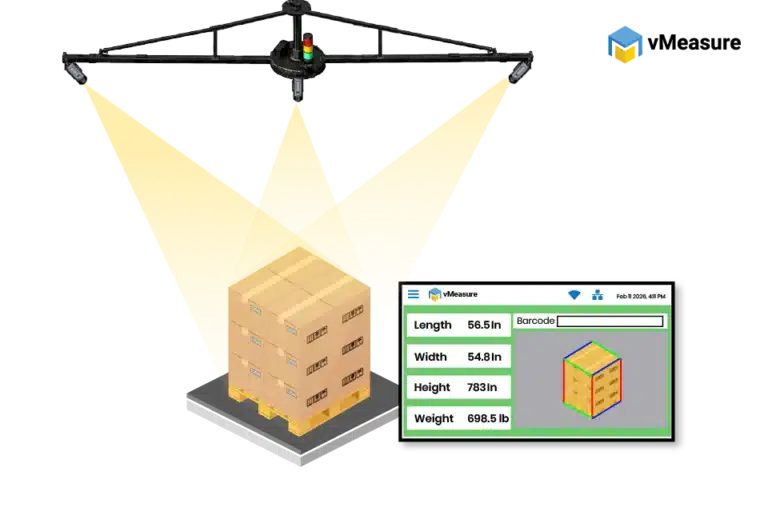
What Is a Pallet Dimensioner?
Before you compare pallet dimensioner machines, it is useful to separate the basic idea from the product features.
A pallet dimensioner is a system used to measure the length, width, and height of palletized freight include images and map that data with a shipment ID. These measurements are used to create or update shipment records.
This helps in freight billing checks, dispatch planning, warehouse receiving, staging, and carrier handoff.
Consider, if a warehouse is moving several pallets a day, manual measurement may still be manageable. But once the volume increases, the process can become slower and less consistent. One operator may measure from one point. Another may measure from a different edge. If the pallet is wrapped, overhanging, or irregular, the difference can become even more noticeable.
A pallet dimensioner gives you a more repeatable way to capture pallet dimensions and store them against the right shipment record.
How Does a Pallet Dimensioner Work?
Once you know what a pallet dimensioner is, the next question is simple: what happens when a pallet is measured?
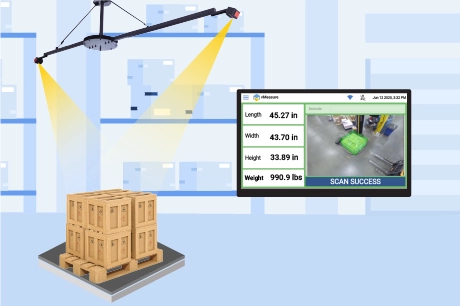
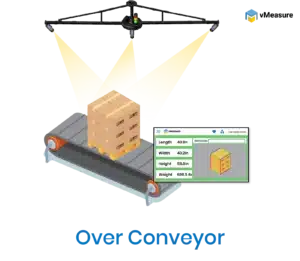
A pallet dimensioner uses cameras, sensors, or scanning technology to detect the palletized freight or shipment. It automatically calculates the pallet’s length, width, and height. That dimensional data can be saved against a shipment ID, order number, load reference, or warehouse record.
A typical workflow looks like this:
- The pallet is moved into the measurement area.
- The operator scans or enters the shipment ID.
- The pallet dimensioner captures the outside dimensions.
- The system records the length, width, and height.
- An image may be captured for proof or audit.
- The data is exported or sent to your warehouse, freight, or shipping system.
The exact process depends on your warehouse layout and the type of pallet dimensioner machine you choose.
Always ensure the measurement should become part of the existing pallet flow, not an extra task that slows everyone down.
What Measurement Range Should You Check Before Choosing a Pallet Dimensioner?
Before you choose a pallet dimensioner, check whether it can measure the palletized shipment sizes you generally handle every day.
Measurement range tells you the minimum and maximum size the system can capture. This usually includes the supported length, width, and height. It matters because palletized freight is not always uniform. Some pallets are standard and compact. Others may be tall, wrapped, irregular, or overhanging.
| Measurement Range Factor | Why It Matters | |
|---|---|---|
|
Minimum length and width |
Useful if you measure smaller palletized loads or compact shipments |
|
|
Maximum length and width |
Important for large, wide, or overhanging pallets |
|
|
Maximum height |
Critical for tall, stacked, or wrapped pallet loads |
|
|
Pallet shape tolerance |
Helps when the load is uneven or not perfectly rectangular |
|
|
Measurement area |
Shows how much floor space is needed for the system |
|
|
Operator clearance |
Ensures forklifts, pallet jacks, and operators can move safely around the setup |
|
| vMeasure pallet dimensioner specifications | ||
|---|---|---|
|
Maximum Dimensions (L – W – H) |
98.4 – 98.4 – 98.4 in 8.2 – 8.2 – 8.2 ft 250 – 250 – 250 cmhidden text |
|
|
Minimum Dimensions (L – W – H) |
9.4 – 9.4 – 4.7 in 0.8 – 0.8 – 0.4 ft 24 – 24 – 12 cmhidden texttx |
|
|
Measurement Accuracy |
Length & Width – 2 cm / 0.8 in Height – 1 cm / 0.4 in |
|
|
Dimensioning Timehidden |
2-3 seconds |
|
|
Installation Height |
4.1 m / 13.4 ft (Complete Setup) 3.6 m / 11.8 ft (Camera Height) |
|

| vMeasure pallet dimensioner specifications | ||
|---|---|---|
|
Maximum Dimensions (L – W – H) |
154 – 150 – 134 in 13 – 12 – 11 ft 390 – 380 – 340 cmhidden text |
|
|
Minimum Dimensions (L – W – H) |
9.4 – 9.4 – 4.7 in 0.8 – 0.8 – 0.4 ft 24 – 24 – 12 cmhidden texttx |
|
|
Measurement Accuracy |
Length & Width – 2 cm / 0.8 in Height – 1 cm / 0.4 in |
|
|
Dimensioning Timehidden |
2-3 seconds |
|
|
Installation Height |
5 m /16 ft (Complete Setup) 4 m / 13 ft (Camera Height) |
|
See how vMeasure pallet dimensioner fits into your operations
Why Do Warehouses Use Pallet Dimensioners?
If you only measure a few pallets occasionally, manual measurement may feel good enough. The problem starts when pallet volume increases or when measurement data affects billing, audit, dispatch, or customer records.
Manual pallet measurement depends on the person measuring, the shape of the load, and how much time is available. A wrapped or overhanging pallet can make the process even harder.
A warehouse pallet dimensioner helps you:
- Reduce manual tape measurement
- Capture pallet dimensions in a more consistent way
- Connect measurements with shipment IDs
- Improve warehouse and freight records
- Save image proof where needed
- Support billing and audit checks
- Make receiving, staging, and dispatch workflows cleaner
This becomes more important when freight pricing or internal planning depends on accurate dimensions. If the length, width, or height is entered incorrectly, it can affect billing reviews, carrier discussions, storage planning, or shipment documentation.
The value is not only speed. It is also about having a record you can trust later.
Pallet Dimensioner vs Manual Pallet Measurement
Manual measurement is familiar. It is also easy to start with because you only need a tape measure and someone to record the values.
But as pallet movement grows, manual measurement can become inconsistent. One person may measure from the pallet base. Another may measure the outer edge of the wrapped load. If the pallet has overhang, the numbers may change again.
A pallet dimensioner gives you a more repeatable process.
| Factor | Manual Pallet Measurement | Pallet Dimensioner |
|---|---|---|
|
Measurement method |
Tape measure or manual tools |
Camera, sensor, or scanning-based measurement |
|
Speed |
Depends on the operator and pallet condition |
Faster and more repeatable |
|
Consistency |
Can vary from person to person |
More standardized measurement process |
|
Record quality |
Often typed or written manually |
Can be linked to shipment records |
|
Image proof |
Usually not captured |
May include image capture |
|
Best fit |
Low-volume or occasional pallet movement |
Warehouses, 3PLs, freight, and industrial operations |
A pallet dimensioner does not replace good warehouse discipline. The pallet still needs to be placed correctly. The right shipment ID still needs to be scanned. The process still needs to be followed.
But it reduces the amount of judgment needed during measurement. That is where the consistency comes from.
If you are still measuring pallets manually, start by checking where the gaps are.
Where Is a Pallet Dimensioner Used in a Warehouse?
A pallet dimensioner works best when it fits naturally into your warehouse flow.
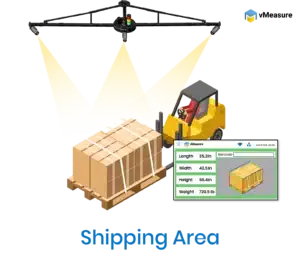
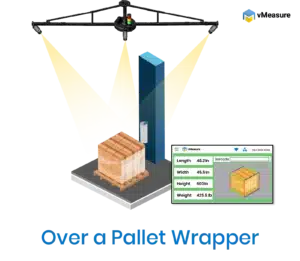
You do not want operators moving pallets to a separate corner just for measurement unless there is a strong reason. The better approach is to place the system where pallets already pause.
A pallet dimensioner gives you a more repeatable process.
| Warehouse Area | How the Pallet Dimensioner Is Used |
|---|---|
|
Receiving |
Capture dimensions when inbound pallets arrive |
|
Staging |
Confirm pallet dimensions before storage or movement |
|
Dispatch |
Record outbound pallet dimensions before carrier handoff |
|
Freight audit |
Compare measured dimensions with billed or declared dimensions |
|
Cross-dock |
Capture dimensional data without disrupting pallet movement |
|
Returns or inspection area |
Record pallet condition and dimensions for review |
For example, if your main issue is inbound freight visibility, receiving may be the right location. If your issue is freight billing or carrier disputes, dispatch or freight audit may make more sense.
The right placement depends on where the measurement is most useful and where the pallet naturally stops.

How Does Pallet Dimensional Data Support Freight Billing?
Freight billing is one of the main reasons buyers start looking at pallet dimensioners.
Carriers may look at the actual weight, dimensional weight, freight class, space usage, or billable weight depending on the shipment type and contract terms. That means pallet dimensions can become important when reviewing charges or explaining billing differences.
Pallet dimensional data helps you:
- Review freight charges
- Compare declared and measured dimensions
- Reduce billing surprises
- Support freight audit workflows
- Improve shipment documentation
- Keep records ready for carrier discussions
A pallet dimensioner gives you a clearer record of what was measured, when it was measured, and which shipment it belongs to.
This does not mean the dimensioner decides the freight charge by itself. Carrier rules, freight class, region, contract terms, and shipment type still matter. But accurate length, width, and height give you a stronger starting point when billing questions come up.
If you are still measuring pallets manually, start by checking where the gaps are.
What Should You Check Before Comparing Pallet Dimensioners?
Before you compare vendors, look at how pallets move through your warehouse, who measures them, where the data is entered, and what happens when a billing or shipment question comes up.
| Buyer Check | Why It Matters |
|---|---|
|
Pallet size range |
The system should handle the pallet sizes you move every day |
|
Maximum height |
Important for tall, stacked, or wrapped pallets |
|
Measurement workflow |
The setup should fit receiving, staging, dispatch, or audit flow |
|
Image capture |
Useful when you need proof for claims or disputes |
|
Shipment ID capture |
Helps connect each measurement to the right record |
|
Data export |
Check CSV, API, webhook, or software export options |
|
Software fit |
Confirm WMS, TMS, ERP, or freight system compatibility |
|
Operator effort |
The process should be simple enough for daily use |
|
Legal-for-trade need |
Required only when measurements are used for regulated commercial transactions |
|
Support and service |
Important for uptime, maintenance, and long-term use |
The biggest mistake is buying a machine before understanding the process around it.
A good pallet dimensioner should not create extra work. It should make measurement easier, make records cleaner, and help your freight or warehouse process run with fewer gaps.
Where vMeasure Fits
If you are exploring pallet dimensioners, you are probably not just looking for a machine. You are looking for a better way to capture pallet dimensions and use that data in your workflow.
That is where vMeasure can fit.
vMeasure helps you bring more structure to pallet measurement by supporting key workflow needs such as:
- Measuring palletized freight
- Capturing length, width, and height
- Linking dimensional data to shipment IDs
- Supporting image capture where required
- Reducing manual measurement effort
- Creating cleaner records for freight and warehouse use
The fit is strongest when you measure pallets regularly and need better records before billing, dispatch, audit, or carrier handoff.
For most buyers, the value is not only in capturing dimensions. The value is in knowing that the right pallet measurement is connected to the right shipment record.
Talk to the dimensioning experts
Still unsure about procuring our dimensioning system for your operations to capture the accurate dimensions, weight, and volume of your SKUs or parcels?
What do our customers say?
"…They are now indispensable components in our shipping process and have allowed us to predict shipping costs accurately…"

Bargain Book Stores
"...vMeasure provided excellent support throughout the product integration process, with readily available and effective after-sales assistance…"

Holisol
"...With vMeasure, we were able to take the cloud-based solution literally under a day and under a far more achievable budget..."

Pidge