
What is an industrial pallet dimensioner?
An industrial pallet dimensioner is an automated pallet dimensioner machine built for warehouses that handle heavy, bulky, wrapped, mixed, or high-volume palletized freight. It captures the length, width, height, and related shipment data of pallets before the freight moves into staging, dispatch, freight billing, or carrier handoff.
An industrial pallet dimensioner measures the full outside freight profile and not just the pallet base. The measurement record should reflect the space the freight occupies on the warehouse floor, in the staging area, and during transport.

How is an industrial pallet dimensioner different from a basic pallet scanner?
| Capability | Basic Pallet Scanner | Industrial Pallet Dimensioner |
|---|---|---|
|
Reads barcode, label, LPN, or pallet reference |
Yes |
Yes |
|
Identifies pallet or shipment reference |
Yes |
Yes |
|
Captures pallet dimensions |
Not always |
Yes |
|
Measures the full outside freight profile |
Not always |
Yes |
|
Supports wrapped, bulky, overhanging, or mixed pallet loads |
Limited |
Yes |
|
Captures image record with the scan |
Sometimes |
Yes |
|
Captures weight with compatible scale integration |
Not always |
Yes, when scale-connected |
|
Connects data to WMS, TMS, ERP, or freight workflows |
Not always |
Yes, when integration is supported |
|
Supports dock checks, outbound verification, audits, and carrier-facing workflows |
Limited |
Yes |
|
Best fit |
Pallet tracking and identification |
Pallet measurement, documentation, and freight workflow support |
Why heavy-duty warehouses need more than basic pallet scanning
What are the most common industrial pallet dimensioning systems available?
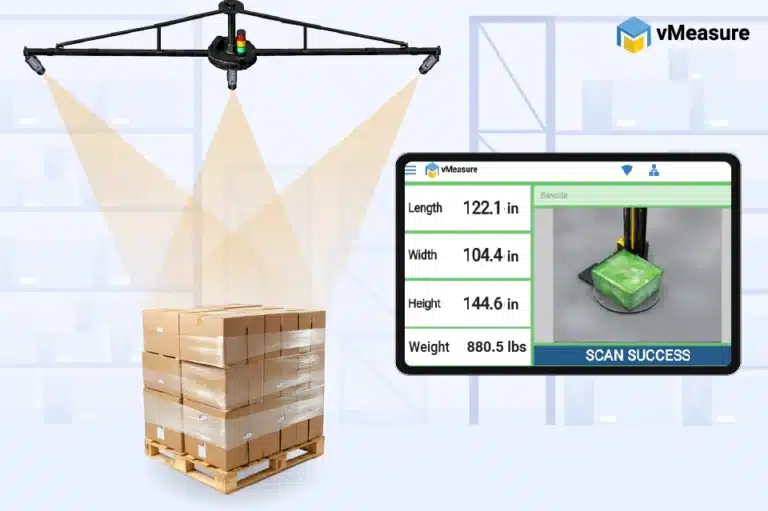
Industrial pallet dimensioning systems come in different setups depending on how pallets move through the warehouse.
| System Type | Best For | Trade-offs |
|---|---|---|
|
Frame-based or portal-frame pallet dimensioner |
Warehouses with a fixed scan point, such as a scale area, audit station, wrapper station, or dispatch lane |
Requires a dedicated installation point and clear pallet placement zone |
|
Static overhead pallet dimensioner |
Operations where pallets can stop under a fixed measurement system |
Supports repeatable scans, but the pallet must be positioned in a defined zone |
|
Drive-through or roll-through pallet scanner |
High-throughput freight areas where forklifts move pallets through a scan gate |
Supports faster movement, but needs more floor space, traffic planning, and investment |
|
Forklift-mounted pallet dimensioning system |
Facilities where pallets do not pass through one fixed measurement station |
Offers flexibility, but consistency depends on forklift position, pallet angle, and operator process |
|
Mobile pallet dimensioning tool |
Lower-volume or flexible sites where a fixed scan station is not practical |
Easier to deploy, but may not provide the same repeatability as a fixed industrial pallet dimensioner |
|
3D vision or depth-sensor pallet dimensioner |
Warehouses that need automated dimension capture for palletized, irregular, or mixed freight |
Performance depends on camera coverage, freight visibility, surface conditions, and approved measurement range |
Which freight profiles should an industrial pallet dimensioner support?
| Freight Type | What the System Should Measure |
|---|---|
|
Standard palletized freight |
Full pallet footprint, height, and occupied load space |
|
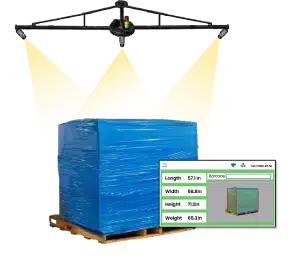
Wrapped pallets |
Final outside profile after stretch wrap |
|
Overhanging pallets |
Freight edges that extend beyond the pallet base |
|
Crated freight |
Outer crate length, width, height, and weight when scale-connected |
|
Tall pallets |
Full high-cube freight height without manual rounding |
|
Irregular cargo |
Widest, longest, and tallest visible points |
|
Bulky manufacturing loads |
Actual load profile before staging or dispatch |
|
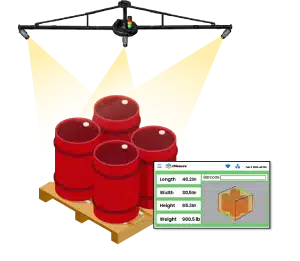
Drums or barrels on pallets |
Outer points of rounded or uneven freight shapes |
|
Mixed outbound pallets |
One consistent record across different pallet shapes |
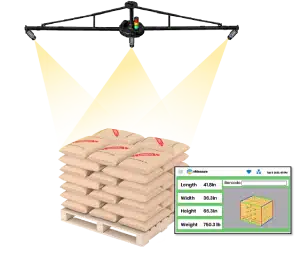
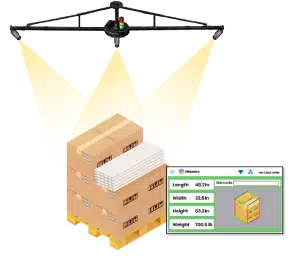
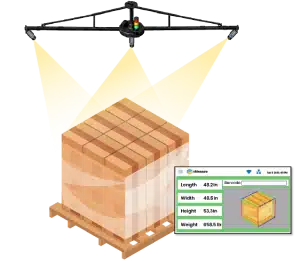
with vMeasure industrial pallet dimensioner
What should buyers evaluate before choosing an industrial pallet dimensioning system?
Buyers should evaluate an industrial pallet dimensioning system based on how well it fits the freight, scan point, operator movement, and data workflow inside the warehouse.
| Evaluation Area | What Buyers Should Check |
|---|---|
|
Freight mix |
Does the system handle standard pallets, wrapped pallets, tall loads, overhang, drums, and irregular freight? |
|
Measurement range |
What are the minimum and maximum measurable length, width, and height? |
|
Scan-zone fit |
Can pallets be placed safely and consistently inside the scan area? |
|
Forklift flow |
Can operators enter, place, scan, and exit without slowing peak pallet movement? |
|
Mounting method |
Does the site support the required wall, ceiling, column, I-beam, floor, or frame setup? |
|
Weight capture |
Can weight be captured in the same workflow through a compatible scale? |
|
Barcode or ID workflow |
Can the scan connect to pallet ID, shipment ID, BOL, LPN, or order number? |
|
Timestamped image record |
Does the record show the pallet image, scan time, and shipment reference? |
|
Data output |
Can the system export dimensions, weight, image, shipment reference, timestamp, and scan history? |
|
Integration |
Does it connect with WMS, TMS, ERP, shipping software, reporting tools, or freight workflows? |
|
Cloud record access |
Can warehouse operators retrieve scan records later for review, audit, reporting, or operational checks? |
|
Throughput |
Does the scan process support daily and peak pallet movement without creating a backlog? |
|
Site readiness |
Are power, network, floor space, lighting, vertical clearance, and obstructions reviewed before installation? |
|
Support |
Are installation, training, calibration support, software updates, and troubleshooting included? |
|
Compliance needs |
If the measurement is used for billing, does the setup need legal-for-trade, NTEP, or OIML review? |
What data should an industrial pallet dimensioner capture in each scan?
How does vMeasure Pallet Ultima fit inside a heavy-duty warehouse?
vMeasure Pallet Ultima fits heavy-duty warehouse workflows where palletized freight needs repeatable dimension capture at a fixed scan point. It is designed to handle a variety of freight, including large, wrapped, overhanging, bulky, or mixed palletized loads that need a consistent measurement record before dispatch, freight audit, or carrier handoff.
The vMeasure automated pallet dimensioner fits near scale areas, wrapping stations, staging lanes, dispatch areas, dock checkpoints, or freight audit stations. Its flexible mounting options include floor, wall, ceiling, column, and I-beam mounting, helping your warehouse place the scan zone where pallets already move.
Talk to the dimensioning experts
What do our customers say?

Bargain Book Stores

Holisol

Pidge