Dimensioners that measure anything from parcels to pallets
vMeasure Dimensioner

Freight Dimensioner Price Guide for Warehouses and Logistics Teams

Freight dimensioner price is not decided by the equipment alone. Two warehouses requesting quotes for the same category of system can receive very different numbers because the final cost depends on measurement workflow, software scope, deployment needs, integration requirements, and support model.
For warehouse and logistics teams, the right way to evaluate freight dimensioner price is to assess the full system scope before comparing vendors. This guide breaks down each cost factor that shapes freight dimensioner pricing.

How much does a freight dimensioner cost?

A freight dimensioner can cost anywhere from around $8,000 to $100,000, depending on the technology used, accuracy level, freight size range, software, installation, integration, and support model.

Pricing of the freight dimensioning solution increases when the system includes weighing, image capture, larger freight coverage, software, integration, or support.
For buyers, the cost usually falls into these broad ranges:
Freight dimensioner type Typical price range What affects the price
Sensor based dimensioning system
$8,000 to $25,000
Simpler detection hardware, limited workflow scope, lower processing requirements
Computer vision freight dimensioner
$12,000 to $45,000+
Depth sensor cameras, processing hardware, image capture, calibration, software, and freight profile coverage
Laser based dimensioning system
$65,000 to $100,000
Precision emitters, receivers, alignment, certification needs, and stricter calibration requirements
The lower end of the range usually applies to simpler measurement setups. The higher end applies when the system needs larger measurement coverage, higher accuracy, legal for trade requirements, scale connectivity, image records, custom software integration, or multiple scan stations.
Accuracy also changes pricing. Higher accuracy requires better hardware, controlled installation, proper calibration, and stronger processing logic. A warehouse handling regular palletized freight needs a different setup than a site measuring mixed pallets, overhanging freight, wrapped loads, protrusions, or irregular freight.
vMeasure enterprise dimensioning solution software integration

How do CapEx and OpEx pricing models affect freight dimensioning system cost?

Freight dimensioning systems are usually paid for in one of two ways. Some companies buy the system upfront. Others pay for it as a running cost.

That choice changes more than the payment method. It affects the first quote, the yearly cost, the service risk, and what the buyer has to pay for later.

CapEx pricing model

CapEx means the buyer pays a higher upfront amount at the start and owns the freight dimensioning solution.
The quote often covers the main hardware. It might also include the mounting setup and basic installation, depending on how the vendor prices the system. This setup works for companies that want to treat the system as a fixed asset.
But first payment is not always the full cost. In many CapEx quotes, software, integration, installation, maintenance, updates, warranty extension, and support are priced separately.
These items matter because they often decide the real long-term cost of the system. A quote may look complete when it lists the hardware price, but buyers should confirm what is included after installation and what becomes a separate charge later.
CapEx can still make sense for buyers with an approved capital budget. But it should be reviewed using total cost of ownership, not only the purchase price.

OpEx pricing model

OpEx model means the buyer pays a lower upfront cost and then pays a recurring monthly or yearly subscription fee.
This makes the freight dimensioner easier to budget because the cost is spread out, instead of paying a huge amount all at once.
It also gives the buyer a clearer idea of what they will spend over time. The subscription includes the system, software access, cloud records, support, updates, and service, instead of leaving each item as a separate cost after purchase.
For many warehouses, this model is easier to justify because the cost can be compared against monthly savings from:
  • Reduced manual measurement
  • Fewer reclass charges
  • Faster freight audit review
  • Cleaner billing records
  • Stronger proof during freight disputes
  • Lower dependency on manual checks
OpEx also helps buyers review total cost of ownership because the subscription keeps cost tied to how the system is used, supported, and maintained over time.

For buyers looking to purchase a freight dimensioning system, OpEx is often the more practical model when they want lower upfront pressure, software access, support coverage, and long-term service included from the start.

Compare which pricing model fits your warehouse better.

How does integration affect freight dimensioning solution cost?

Integration affects freight dimensioning solution cost because the captured freight data has to move into the systems the warehouse already uses. A standalone freight dimensioning system may only capture measurements. An integrated setup connects dimensions, weight, barcode, shipment ID, images, and scan history with the buyer’s existing workflow.
Common integration methods include:
Integration method Cost impact
REST API
Costs more when live data needs to move directly into another system
Webhooks
Adds setup work when scan results need to be sent automatically after measurement
Middleware
Adds cost when two systems cannot connect directly
CSV export
Usually lower cost because records can be exported and uploaded manually
JSON export
Usually lower cost when structured data is shared without deeper system integration
Browser-based workflow
Adds cost when the vendor has to configure data transfer into an existing web system
Flat file or SFTP
Usually lower cost for scheduled file transfers or legacy workflows
dimensioning solution software integration
A standard export is usually simpler because the system only needs to send the measurement records through CSV, JSON, flat file, or SFTP. These options usually cost less because they move data through files, not through a deeper system connection.
Custom integration costs more because it involves additional work. The vendor need to map fields, test the data flow, handle exceptions, set up system triggers, and work with the buyer’s IT or operations team.
Integration is not only an IT requirement. It also affects how easily operators use the system every day.

If operators have to measure freight in one system, copy the values, open another screen, and retype shipment details, the new freight dimensioning & weighing solution setup can add more steps to the workflow. When the freight dimensioning solution connects with the existing workflow, operators can keep working in the process they already know.

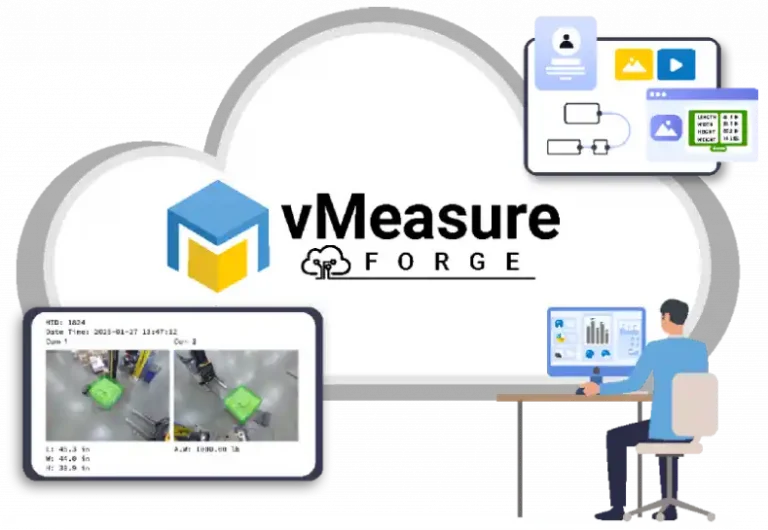
With vMeasure Forge, a cloud-based dimensioning solution, integration is planned around the warehouse workflow. The system connects through REST APIs, webhooks, middleware, CSV or JSON exports, browser-based workflows, or flat-file transfer, depending on how the buyer’s system is set up.

This helps warehouses move freight data into existing systems without building the whole workflow around the dimensioner.
Get a custom quote for your freight workflow and integration needs.

How do deployment and installation affect freight dimensioner pricing?

Deployment and installation change the final cost because the freight dimensioner still has to be made ready for the warehouse floor. It has to be placed correctly, mounted, calibrated, connected to power and network, tested, and handed over to the team that will use it every day.
The hardware price may look fixed at first. The quote changes when the site needs extra work before go-live. Common items include site review, mounting materials, installation labor, scale validation, power checks, network checks, software setup, operator training, and go-live support.
Installation cost increases when the warehouse needs special mounting, longer cabling, lift equipment, technician travel, after-hours installation, or a second site visit. Buyers should ask the vendor to show what is included in the quote and what will be charged separately.
With a CapEx purchase, the buyer often pays for the freight dimensioner first. Installation, calibration, support, and extra onsite work appear as separate costs. With an OpEx model, standard deployment and installation are usually included in the subscription scope, so the buyer does not have to treat them as separate upfront expenses.

What software platform costs should buyers check?

Software cost is part of freight dimensioner pricing because every scan creates a record. That record has to be stored and used later. The warehouse team also needs to open it later, review it, export it, and connect it with the shipment or freight audit workflow.
Buyers should ask how the vendor charges for the software behind the system. Look at scan volume, record storage, image retention, number of users, reports, exports, API or webhook use, software updates, and support. These items are easy to miss during the first price discussion, but they affect the cost over time.
With a CapEx purchase, the quote usually starts with the hardware price. Software costs often come in separately. Cloud access, image storage, reports, API access, support, updates, or extra users might be billed as add-ons or renewed later.
With an OpEx pricing model, software access is usually included in the subscription. The cost changes only when the buyer needs extra users, storage, scans, exports, or longer record retention.
For warehouses handling more freight each month, OpEx is usually easier to plan. The software cost follows how the system is used, instead of turning into separate line items after the hardware is purchased.
Discuss your software requirements and get transparent freight dimensioner pricing.

How does the support model affect freight dimensioner pricing?

Support affects the price because the freight dimensioner still needs help after it goes live.
Some warehouses only need basic remote support. Others need faster help, onsite service, calibration guidance, integration support, or support for more than one scan station.
This matters because the freight dimensioning & weighing solution is part of the daily warehouse workflow. When a scan station has an issue and support is not included, your warehouse team may have to measure freight manually again. They may also have to do extra checks, write down values, or enter the same data into another system.
Buyers should look at support based on how the warehouse works every day. Check your freight volume, number of scan stations, shift hours, warehouse conditions, and the technical support available inside your team.
With CapEx pricing, support is usually charged separately after the hardware purchase. Remote troubleshooting, onsite visits, warranty extensions, calibration help, and live support after installation all add to the cost.
With OpEx pricing, support is usually included in the subscription. This makes it easier for warehouses with growing freight volume, longer working hours, or limited in-house technical support. The support cost is planned from the start as part of the regular operating cost.
Financial
Service
Software
subscription plan

Where does vMeasure Pallet Ultima fit in freight dimensioner pricing?

vMeasure Pallet Ultima fits buyers who prefer an OpEx-style pricing model.

The buyer purchases the hardware once. The subscription then supports ongoing customer support, software updates, and long-term system performance.
The model includes lifetime hardware coverage and 24/7 customer support. Continuous customer training is also available at an additional cost.
vMeasure offers transparent, all-inclusive pricing with no hidden fees. Buyers do not have to pay separately for basic areas such as annual maintenance service, warranty coverage, or additional software modules.
This gives you a clearer view of the cost over the years. Instead of paying separately for support, updates, service, and warranty-related needs later, the main costs are planned within one subscription model.

Talk to the dimensioning experts

Still unsure about procuring our dimensioning system for your operations to capture the accurate dimensions, weight, and volume of your SKUs or parcels?

What do our customers say?​