
Cargo rarely arrives as a perfect cube.
A pallet reaches the freight dock with cartons leaning slightly over one edge. A crate arrives with a wider base than expected. Airport cargo moves toward documentation, but the shipment record still depends on a manual tape measurement.
Freight, air cargo, and mixed shipments do not always follow clean shapes. One load may be palletized. Another may be wrapped. Another may include crates, drums, cartons, or irregular cargo that extends beyond the pallet footprint. When these shipments are measured by hand they eventually end up being incorrect and lead to shipment misclassification and incur charges.
A cargo dimensioning system solves this by creating a structured measurement record.

What is a cargo dimensioning system?
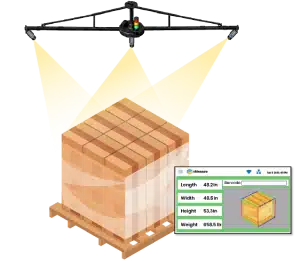
A cargo dimensioning system accurately measures the length, width, and height of any shaped freight, pallets, air cargo, or mixed shipments. It creates a digital record that includes shipment ID, timestamp, images, export data, and weight when connected to a compatible and validated scale.
How Does Cargo Dimensioning Work?
A cargo dimensioning system works by capturing the visible outer profile of a load and calculating its external dimensions. The freight is positioned within a defined measurement area, identified using a shipment reference and scanned. The resulting dimension record are then stored, reviewed or sent into another warehouse or freight workflow.
A typical workflow looks like this:
Step 1: Freight arrives at the scan location.
Step 2: Place the pallet, crate, or cargo unit in the measurement zone.
Step 3: Scan or enters a shipment reference, such as AWB, BOL, PO, pallet ID, LPN, or shipment ID.
Step 4: The automated dimensioning system captures length, width, and height along with the weight from the connected weighing scale
Step 5: Images are captured for proof and review.
Step 6: The record is stored, exported, or sent to another system.
Step 7: The cargo moves to staging, storage, dispatch, loading, or carrier handoff.
Measure all kinds of palletized freight in 2 seconds
with vMeasure cargo dimensioning system
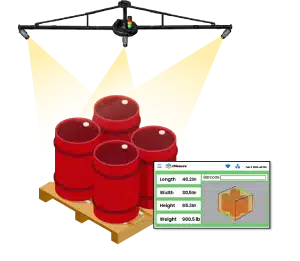
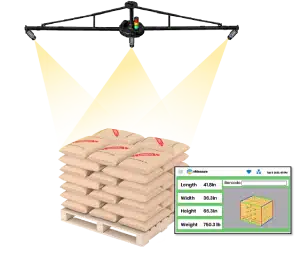
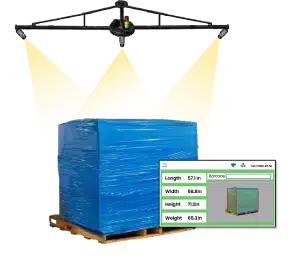
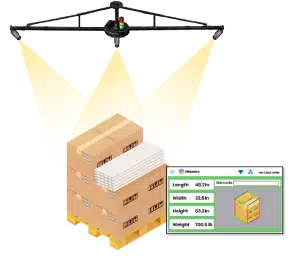
Can a Cargo Dimensioning System Measure Irregular Freight?
Yes, some cargo dimensioning systems are designed to measure irregular freight by capturing the maximum visible outer dimensions of a load rather than assuming a clean rectangular box. This is relevant for palletized cargo with overhangs, uneven stacking, protruding products, barrels, machinery parts or wrapped loads.
Irregular cargo is harder to measure manually because the person measuring it must identify the furthest outer points and record them consistently. That becomes difficult when the freight is:
- unevenly stacked
- wider than the pallet base
- covered in shrink wrap
- made up of mixed item profiles
- shaped by protrusions or rounded objects
- moved quickly through a warehouse or freight facility
vMeasure Pallet Ultima captures accurate dimensions of cartons stacked on pallets, crates on pallets, drums or barrels on pallets, wrapped palletized loads, mixed freight on pallets, and visible overhang. It also captures protrusions greater than 0.10 ft / 1.2 in / 3.0 cm / 0.03 m.
See how vMeasure pallet dimensioner fits into your operation
How Is Cargo Dimensioning Relevant to Air Cargo?
Air cargo operations handle shipments where cargo size affects handling, loading preparation, use of cargo space and the information available for shipment review. A cargo dimensioning system help capture the physical dimensions of freight before it moves through export cargo handling or air cargo preparation stages.
In air cargo contexts, relevant shipment forms include:
- loose cargo
- palletized export cargo
- mixed cargo prepared for consolidation
- irregular cargo requiring fit review
- cargo prepared for a Unit Load Device, or ULD
- cargo prepared around a PMC pallet configuration
Where Is a Cargo Dimensioning System Used?
A cargo dimensioning system works best when it is placed where freight already pauses, gets checked or changes handling status.
| Operational Location | Typical Cargo Context | Purpose of Dimension Capture |
|---|---|---|
|
Receiving station |
Incoming pallets, crates or mixed freight |
Record dimensions when cargo enters the facility |
|
Freight audit point |
Shipment records under review |
Compare measured data with declared information |
|
Staging area |
Palletized or mixed cargo awaiting movement |
Confirm dimensions before transfer |
|
Dispatch checkpoint |
Outbound freight |
Capture final dimensional record before release |
|
Carrier handoff point |
Freight transferring to a carrier |
Keep measurement and image proof before handoff |
|
Export cargo preparation area |
Freight being prepared for international movement |
Link dimensions with shipment references |
|
Airport cargo handling area |
Air cargo or consolidation workflows |
Support handling and load-fit review, subject to deployment validation |
|
Cross-dock workflow |
Cargo moving rapidly between inbound and outbound flows |
Capture dimensional data without relying on manual notes |
Capture cleaner dimension records before freight moves to staging, dispatch, or carrier handoff
Cargo Dimensioning System vs Manual Measurement
Manual measurement can still work when cargo volume is low and dimensional records are rarely needed. As freight becomes more varied or the record becomes important for billing, audit or handoff, manual measurement becomes harder to keep consistent.
| Comparison Point | Manual Measurement | Cargo Dimensioning System |
|---|---|---|
|
Measurement method |
Tape measure or manual tool |
Camera, sensor or scanning-based capture |
|
Irregular cargo handling |
Depends on operator judgement |
Capture maximum visible load profile, subject to system capability |
|
Record creation |
Often written or entered separately |
Can be linked to a digital shipment record |
|
Image proof |
Usually not captured as part of measurement |
Captured with the scan |
|
Consistency |
Can vary by operator or location |
Uses a defined measurement process |
|
Best fit |
Occasional, low-volume measurement |
Freight operations requiring repeatable records |
|
Review later |
Limited unless manually documented |
Searchable record helps support later review |
What Should Buyers Look for in a Freight Dimensional Scanner?
A freight dimensional scanner should be evaluated based on measurement fit, workflow fit, data capture, scale validation, integration needs, image proof, cloud access, and operational limits. The right system depends on cargo size, freight type, stop location, software workflow, and proof requirements.
| Evaluation Area | What to Check |
|---|---|
|
Freight type |
Pallets, crates, mixed cargo, airport cargo, wrapped loads, irregular freight |
|
Measurement envelope |
Minimum and maximum measurable size by cargo height and footprint |
|
Accuracy |
Length, width, and height tolerance |
|
Irregular freight handling |
Overhang, protrusions, non-square loads, mixed freight |
|
Scale workflow |
Scale model, indicator model, output mode, cable, data format |
|
ID workflow |
Barcode, AWB, shipment ID, BOL, PO, LPN, manual entry |
|
Image proof |
Built-in images, auxiliary views, image links, proof use cases |
|
Integration |
WMS, TMS, ERP, OMS, rate engine, carrier software |
|
Export options |
CSV, JSON, API, webhooks, flat file, browser workflow |
|
Cloud and retention |
Record lookup, storage period, export process |
|
Limitations |
Black shrink wrap, shiny surfaces, freight outside the measurement range |
|
Legal claims |
NTEP and legal-for-trade status must be confirmed before publishing or promising |
Where vMeasure Fits into Cargo and Freight Dimensioning Workflows
vMeasure fits operations that need to capture dimensions and images for palletized freight and certain irregular pallet-load profiles, then integrate those measurement records with freight or warehouse workflows.
vMeasure Pallet Ultima captures:
- Length
- Width
- Height
- Barcode or ID
- Timestamp
- Images
- Weight when connected to a compatible and validated scale
- Exportable scan records
Need to measure freight, pallets, airport cargo, or mixed shipments at a repeatable scan point?
Frequently asked questions
1. What Are ULDs and PMC Pallets in Air Cargo?
A Unit Load Device, commonly referred to as a ULD, is a pallet or container used in aircraft cargo handling. A PMC is a type of air cargo pallet used for specific aircraft loading configurations
2. How do cargo dimensioning systems integrate to WMS and TMS workflows?
Once the dimensions is captured by the cargo dimensioner, the record includes dimensions, shipment ID, timestamp, images, and weight when scale connected. This data moves into WMS, TMS, ERP, OMS or carrier software through APIs, webhooks, CSV/JSON export, flat files, browser workflows, or other approved integration paths.
3. What are the limitations of automated freight dimensioning systems?
Automated freight dimensioning systems measure the outside size of freight, but they should not be treated as all-purpose freight automation tools. Buyers should check the limits before selecting a system, especially for mixed cargo, irregular freight, scale workflows, and freight compliance needs.
Common limitations include:
- They may not count cartons or individual items
- They may not identify SKUs
- They may not verify pallet contents against an order
- They may not detect damage automatically
Talk to the dimensioning experts
Still unsure about procuring our dimensioning system for your operations to capture the accurate dimensions, weight, and volume of your SKUs or parcels?
What do our customers say?
"…They are now indispensable components in our shipping process and have allowed us to predict shipping costs accurately…"

Bargain Book Stores
"...vMeasure provided excellent support throughout the product integration process, with readily available and effective after-sales assistance…"

Holisol
"...With vMeasure, we were able to take the cloud-based solution literally under a day and under a far more achievable budget..."

Pidge